
Drawing on both her experience working internationally across the art world and her current training as an integrative psychotherapist and hypnotherapist, Valeria Szabó Facchin explored the psychology behind building and sustaining meaningful professional relationships.
Valeria began the session with a short guided meditation, asking us to imagine walking into a room at an art world event. What emotions come up? Does the way we speak, dress or carry ourselves change? How much of that is genuinely us? She also encouraged us to return to a fundamental question: Why did you want to enter the art world in the first place? The answer is something worth holding on to throughout your career.
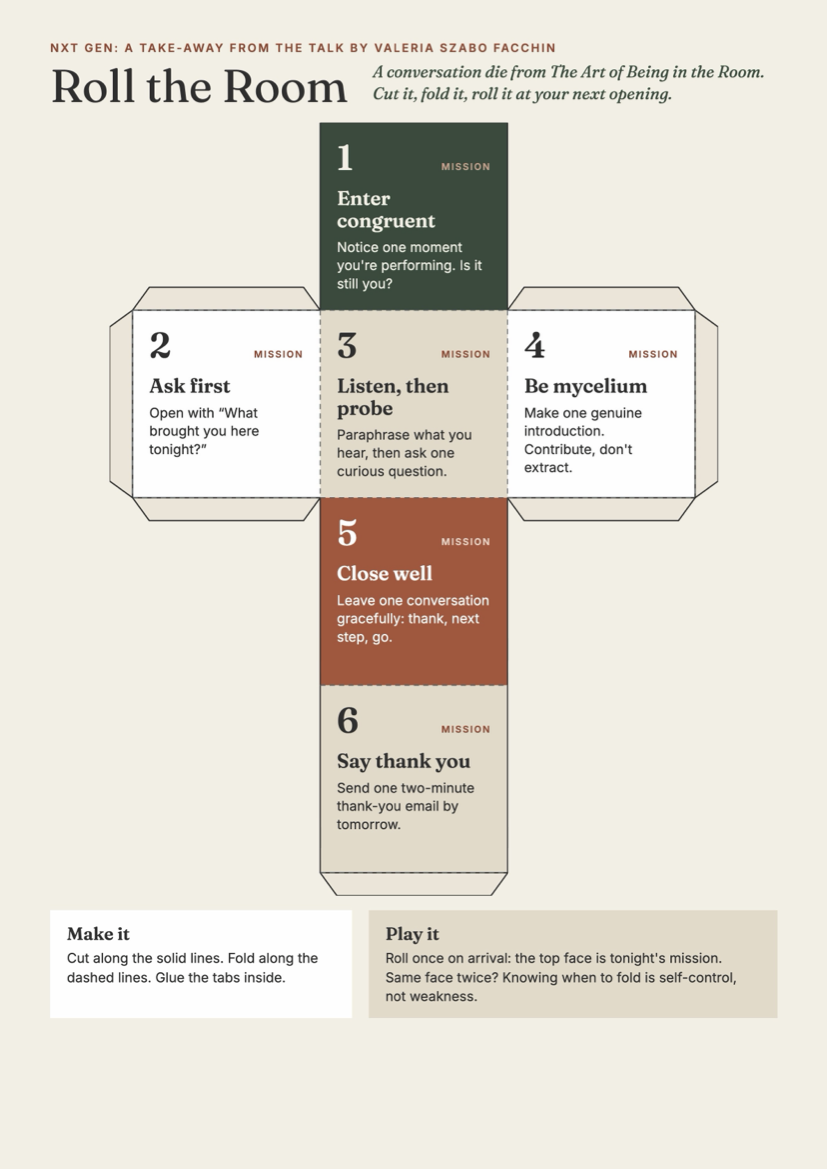
Full recording and written takeaways are below. Valeria has also created some worksheets.
9 Takeaways
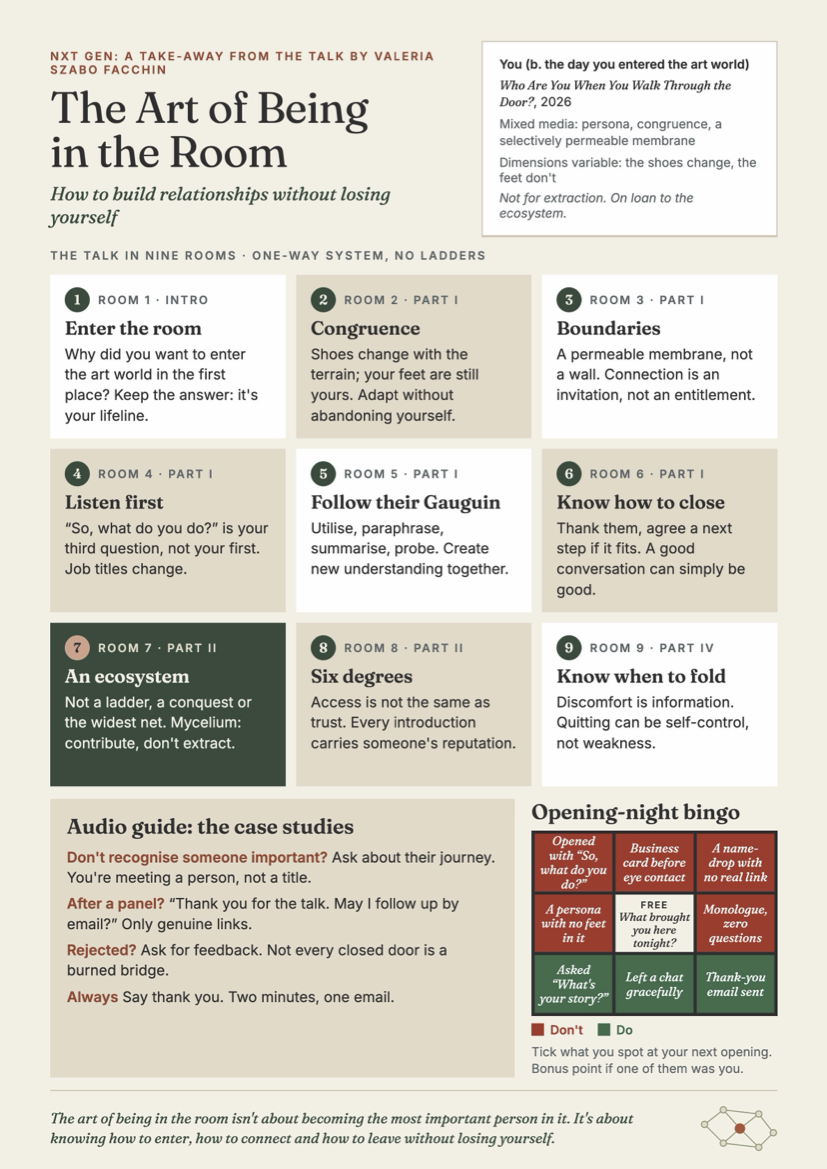
1. Adapt to your environment without losing your identity
Valeria introduced the psychological concepts of persona and congruence using the analogy of footwear. You would choose different shoes to go hiking than you would to go swimming. The shoes change according to the environment but the feet underneath remain the same.
The same applies to professional environments. It's natural to adapt how we present ourselves in different settings but there should still be a recognisable sense of self underneath.
2. Connection is an invitation, not an entitlement
Valeria described boundaries as a membrane rather than a wall - they allow us to connect with others while maintaining our own autonomy. For a genuine connection to develop there needs to be openness on both sides. Pay attention to facial expressions, body language and how someone responds to your presence. Recognise when someone is receptive to a conversation and when they aren't.
3. Don't make “What do you do?” your opening question
By immediately asking someone what they do professionally, we risk communicating that we are assessing their value according to their position.
“How useful might this person be to me?”
Instead, Valeria suggested opening a conversation with questions that demonstrate genuine curiosity:
What brought you here tonight?
What's your story?
How did you become interested in this exhibition?
Job titles change. Today's assistant could be tomorrow's institutional director. Someone's current position tells you very little about their wider interests or potential.
4. Listen to understand rather than to respond
Valeria asked us to consider what we gain from an encounter if we spend the entire conversation talking about ourselves. She introduced four communication techniques that help develop more meaningful conversations:
Utilisation: Take something the other person has shared and use it constructively to develop the conversation.
Paraphrasing: Reflect what someone has said in your own words to demonstrate understanding.
Summarising: Bring together several points someone has made during a conversation.
Probing: Ask follow-up questions to gently explore an idea further.
5. Learn the art of closing a conversation
We spend considerable time thinking about how to approach someone but rarely consider how to leave them. Recognise when a conversation has reached its natural conclusion. Acknowledge the time you've shared and agree on a next step if appropriate. Not every conversation needs to lead somewhere.
6. Think of networking as an ecosystem rather than a ladder
“I prefer to think about networking as building an ecosystem.”
Valeria used the analogy of mycelium - a network of fungal threads through which resources can be exchanged. For your networking ecosystem to remain healthy there needs to be reciprocity. This doesn't mean an immediate exchange or expecting something in return for a favour. It is about recognising that relationships are sustained through mutual contribution.
7. Access is not the same as trust
Drawing on the concept of six degrees of separation, Valeria explained how seemingly inaccessible people might be reachable through a surprisingly short chain of relationships.
However, having someone's contact details does not mean you have earned access to their wider network. When someone makes an introduction they are putting a degree of their own professional reputation behind it. We have a responsibility to respect the relationships that existed before we entered that network. How we behave within it matters.
8. Don't pretend to know someone you don't recognise
If you're introduced to an influential figure in the art world and have no idea who they are, approach the encounter with genuine curiosity rather than feeling embarrassed. Ask how they came to work in their field. Was it something they always wanted to do? What challenges did they encounter along the way?
Valeria finds people's professional journeys more interesting than their job titles. She also stressed the importance of recognising when someone has limited time or is distracted.
9. Be clear, relevant and respectful when approaching a speaker
If you know in advance that you would like to meet someone, do some research beforehand.
Valeria demonstrated how to approach a speaker by introducing herself, acknowledging their contribution and identifying something specific she found interesting. She would then establish a relevant connection to her own research or professional interests before asking permission to follow up.
She emphasised not to manufacture connections to make yourself appear more valuable. There is nothing wrong with being in the process of learning.